
Class 8 Truck Orders
May 2026 Class 8 Truck Orders & Industry Outlook
ACT Research delivers proprietary, forward-looking analysis of Class 8 truck orders to help industry leaders plan capacity and capital investments with confidence.
Class 8 Truck Orders
May 2026 Update
May 26, 2026
Class 8 order activity moderated in April, but remained consistent with a market transitioning off the bottom. Tractor demand continues to benefit from better rate conditions and tighter capacity, while vocational demand remains supported by infrastructure, utility, grid, data-center, and AI-related investment.
Backlog and production signals remain constructive. Backlogs improved from the prior month, giving OEMs better production visibility, while build plans moved higher. Retail sales remain a more cautious signal, suggesting fleet capital deployment is still disciplined and closely tied to profitability, financing conditions, and confidence in the freight-rate recovery.
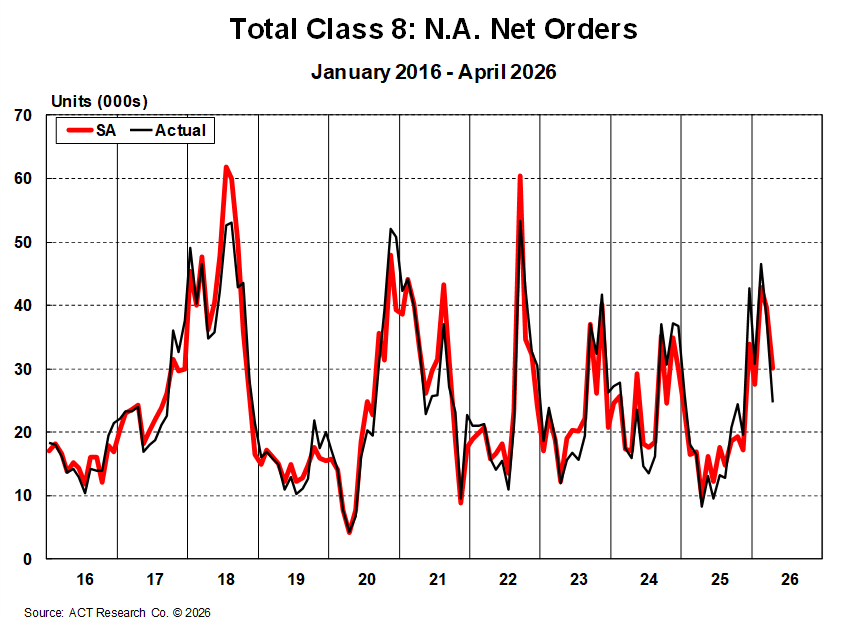
Class 8 Truck Orders Snapshot
May’s Class 8 truck orders update points to a recovery that is improving, but still uneven. The strongest support is coming from supply-side tightening, regulatory-driven capacity pressure, replacement demand, and improving freight rates.
OEMs continue to benefit from better backlog visibility, while fleets remain disciplined around timing and total cost of ownership. Dealers, suppliers, lenders, and investors should continue watching backlog quality, cancellation activity, retail sales, and whether higher freight rates translate into healthier carrier profitability.
The setup is more constructive than earlier in the cycle, but not yet broad-based. If capacity remains constrained and freight rates continue to firm, Class 8 order activity should remain supported as 2026 progresses.
With April order activity easing from March, Class 8 truck orders remain consistent with a supply-driven early-cycle recovery rather than a broad-based demand surge. Orderboards are rebuilding from depressed levels, while OEMs continue to manage production carefully and backlogs provide improved visibility. The market’s challenge has shifted from backlog erosion and weak demand toward tighter capacity, improving freight rates, and still-fragile carrier profitability. Regulatory clarity around 2027 equipment timing continues to support planning, while driver-related policy changes and FMCSA enforcement are constraining capacity. Elevated fuel, insurance, financing, and equipment costs remain pressure points for total cost of ownership. Vocational demand remains resilient, supported by infrastructure, utility, grid, data-center, and AI-related investment, but retail activity is still measured, leaving fleets focused on disciplined replacement and regulatory positioning rather than broad-based expansion.

Kenny Vieth
President & Senior Analyst

Resources
Whether you’re new to our company or already a subscriber, we encourage you to take advantage of all our resources.