Class 8 Truck Market: 2027 Outlook
May 2026
Updated May 27, 2026
The Class 8 Tractor Sales Forecast 2027 is being shaped by the supply-driven tightening now developing in 2026, along with EPA 2027 planning, replacement timing, financing conditions, and used truck value movement. Current Class 8 signals suggest the market is moving beyond the bottom of the prior cycle, but buyer behavior remains disciplined.
ACT’s latest source guidance identifies Class 8 demand trends, tractor orders, replacement-cycle timing, freight-rate impacts, carrier profitability signals, EPA 2027 pull-forward demand, production expectations, used truck implications, and buyer timing decisions as the key inputs for the 2027 forecast page.
Regulatory Pressures
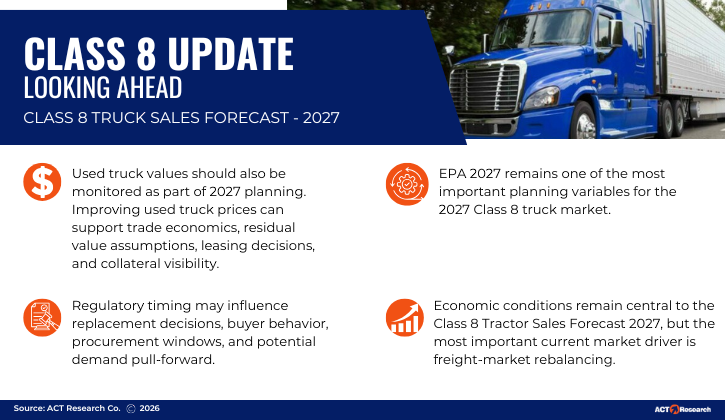
EPA 2027 remains one of the most important planning variables for the 2027 Class 8 truck market. Regulatory timing may influence replacement decisions, buyer behavior, procurement windows, and potential demand pull-forward. The March 2026 version noted that EPA 2027 was already the defining force shaping the 2027 Class 8 outlook, with improving regulatory clarity supporting fleet planning visibility.
Current signals suggest fleets are likely to evaluate 2027 purchases through a cost-sensitive lens. Higher expected equipment costs, financing conditions, insurance, maintenance, compliance, and operating expenses may keep replacement and pre-buy activity measured rather than aggressive. For fleets, dealers, lenders, leasing firms, and manufacturers, the key planning question is how regulatory timing interacts with freight-rate recovery and replacement needs.
Stabilized Market Growth
The Class 8 market is positioned to enter 2027 on firmer footing than it had through the prolonged 2024–2025 downturn. Capacity is tightening, driver availability is more constrained, and freight-rate momentum is improving. These conditions are helping support Class 8 demand, particularly where replacement needs are becoming harder to defer.
At the same time, the 2027 truck market is not shaping up as a broad expansion cycle. The March version framed 2027 growth as driven by replacement demand, regulatory timing, and measured prebuy activity rather than speculative volume growth. That remains the right planning lens.
For buyers and commercial vehicle stakeholders, the signals to monitor are order timing, replacement commitments, freight-rate durability, carrier profitability, used truck values, and financing sensitivity. Stronger rates may improve purchasing confidence, but elevated equipment costs and capital discipline could limit broad capacity expansion.
Economic Factors
Economic conditions remain central to the Class 8 Tractor Sales Forecast 2027, but the most important current market driver is freight-market rebalancing. Freight demand remains uneven, while tighter capacity is helping lift spot and contract rate conditions. That matters because Class 8 tractor demand is closely tied to fleet confidence, utilization, profitability, and replacement-cycle timing.
Used truck values should also be monitored as part of 2027 planning. Improving used truck prices can support trade economics, residual value assumptions, leasing decisions, and collateral visibility. For fleets and lenders, used equipment trends may influence whether replacement decisions become easier to justify as the market improves.
The March 2026 version noted that most fleets were expected to enter 2027 with capital budgets centered on compliance, essential replacement, equipment optimization, and balance-sheet preservation rather than aggressive growth. That remains a useful framing for 2027 buyers.
For Class 8 market participants, the planning takeaway is measured improvement. EPA 2027 timing, tighter capacity, stronger freight rates, and replacement needs may support demand, but financing costs and still-recovering carrier profitability are likely to keep buying decisions disciplined.

Want more data?
ACT’s commercial vehicle forecast delivers the most reliable, forward-looking insight into where Class 8 truck sales are headed—helping you anticipate shifts, plan with confidence, and stay ahead of the market.