2026 Class 8 Truck Market
May 2026
Updated May 27, 2026
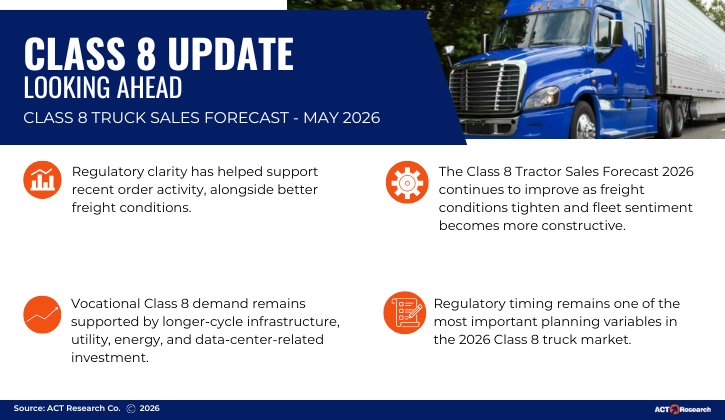
The Class 8 Tractor Sales Forecast 2026 continues to improve as freight conditions tighten and fleet sentiment becomes more constructive. The market is not yet in a broad expansion cycle, but current signals show a clearer transition away from the prolonged downcycle that shaped 2024 and 2025.
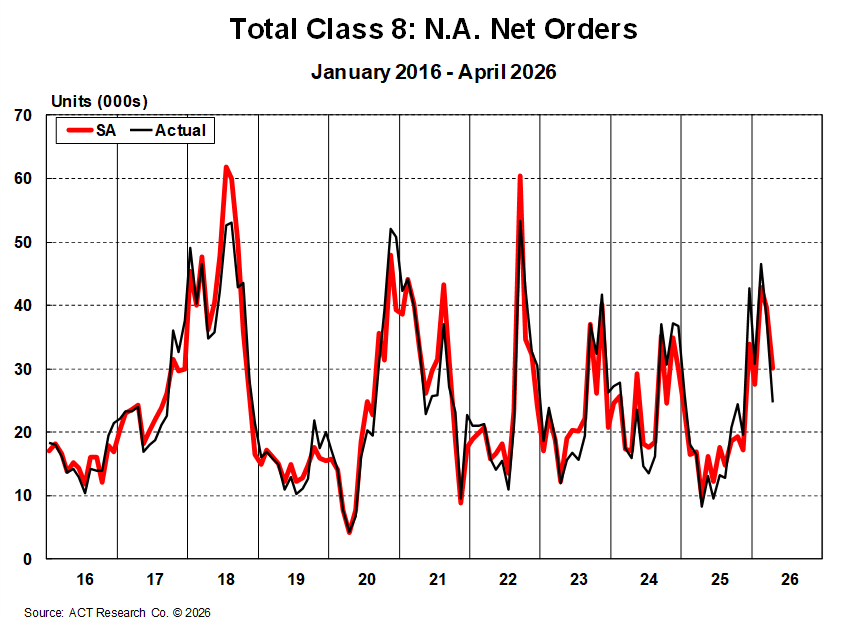
ACT’s May reports point to a supply-driven recovery. Truckload capacity has tightened, spot rates have strengthened, and contract rates are beginning to follow. Class 8 order activity cooled from March to April, but that movement was consistent with normal seasonality as the industry entered a slower order period before 2027 orderboards open later in the year.
Infrastructure and Construction Support
Vocational Class 8 demand remains supported by longer-cycle infrastructure, utility, energy, and data-center-related investment. These segments are providing steadier support than many goods-producing markets, even as housing and some industrial activity remain uneven.
For 2026 planning, the key point is that vocational demand is stabilizing rather than accelerating sharply. Infrastructure-aligned activity and AI-related data center investment may continue to support medium-term visibility, but broader freight and construction demand still need stronger follow-through before the segment can be viewed as fully expansionary. The March live version also identified infrastructure, energy-sector activity, and data-center investment as important support factors for vocational demand.
Production and Backlogs
Class 8 production remains disciplined, but order and backlog signals are more constructive than they were through much of the prior downcycle. ACT’s latest Classes 5–8 data shows Class 8 orders declined from March to April, in line with normal seasonal patterns, while backlogs remained elevated and build plans improved.
That matters for fleets, buyers, dealers, lenders, and suppliers because the market is gaining forward visibility without showing signs of uncontrolled expansion. Replacement needs, rate improvement, and regulatory timing are supporting demand, while financing costs and operating expenses continue to keep fleet buying behavior disciplined.
Regulatory Shifts
Regulatory timing remains one of the most important planning variables in the 2026 Class 8 truck market. EPA 2027 continues to influence replacement timing, procurement planning, and expectations for higher future equipment costs. ACT’s latest Classes 5–8 report notes that regulatory clarity has helped support recent order activity, alongside better freight conditions.
Driver-related policy changes are also affecting the market. ACT’s May Freight Forecast and Commercial Vehicle Outlook point to stricter nondomiciled CDL rules, FMCSA activity, ELD scrutiny, and Roadcheck-related tightening as contributors to reduced available capacity. These developments may support freight-rate momentum and improve the economics behind replacement decisions.
Capacity Rebalancing
The Class 8 sector continues to rebalance as capacity tightens and freight rates improve. ACT’s May Commercial Vehicle Outlook notes that a cyclical driver shortage is emerging for the first time since the previous driver shortage cycle ended in early 2022. That is an important signal for the Class 8 tractor sales forecast because tighter driver availability can support stronger freight rates even without a sharp freight-demand rebound.
Used truck signals are also becoming more constructive. ACT’s May Used Trucks report shows April same-dealer used Class 8 retail sales eased month over month but improved year over year, while average retail pricing moved higher. For fleets and lenders, stronger used truck values may help improve residual-value visibility and support replacement-cycle confidence.
Moderate Growth in Orders
Class 8 order activity is no longer at trough levels, but the market remains disciplined. April orders moved lower from March, which ACT characterized as consistent with weaker seasonal order patterns. The stronger signal is that recent demand has been supported by improved spot and contract rates, tighter capacity, regulatory clarity, and buyer focus on 2027 planning.
For commercial vehicle decision-makers, this points to a measured recovery rather than a broad-based surge. Fleet replacement demand is improving, but purchase decisions remain sensitive to financing conditions, operating costs, future equipment pricing, and confidence in rate durability.
Economic Tailwinds and Risks
The 2026 Class 8 truck market is benefiting from improving freight economics, infrastructure-related activity, and tightening capacity. At the same time, elevated fuel costs, insurance, financing, and maintenance expenses continue to affect carrier profitability and equipment-purchase timing.
ACT’s May Freight Forecast shows that spot market conditions tightened meaningfully around Roadcheck, while contract rates continued to move higher with a lag. If rate improvement remains durable, it may support stronger fleet confidence and replacement activity through the balance of 2026.
The practical takeaway: the Class 8 tractor market is on firmer footing than earlier in the cycle, but demand is still being shaped by replacement discipline rather than broad expansion. Fleets, buyers, dealers, lenders, leasing companies, and investors should continue monitoring freight-rate sustainability, driver availability, regulatory timing, used truck values, and financing conditions as the 2026 truck market develops.

Want more data?
ACT’s commercial vehicle forecast delivers the most reliable, forward-looking insight into where Class 8 truck sales are headed—helping you anticipate shifts, plan with confidence, and stay ahead of the market.